Satyabhama Majhi and the Changing Face of Contemporary Indian Art
Contemporary Indian art has increasingly moved beyond the boundaries of traditional studio practice. Artists today are exploring questions of identity, environment, community, memory, indigenous knowledge and social change through an expanding range of media. Satyabhama Majhi, a contemporary visual artist, curator, social activist and community art practitioner from Odisha, represents this broader understanding of artistic practice.
Based in Bhubaneswar, Majhi has developed a multidisciplinary career spanning painting, sculpture, installation, photography, mixed media, public art and community-based projects. Her work reflects the changing nature of contemporary Indian art while remaining closely connected to the cultural and environmental realities of Odisha.
Her artistic practice demonstrates how contemporary art can draw from traditional knowledge without remaining confined to the past. Through her work, traditional visual references, natural materials, community participation and modern artistic approaches come together to create a distinctive visual language.
Contemporary Art Beyond the Gallery
One of the defining characteristics of contemporary Indian art is its movement beyond conventional exhibition spaces. Artists increasingly engage with streets, communities, schools, rural environments and public institutions.
Majhi’s career reflects this development.
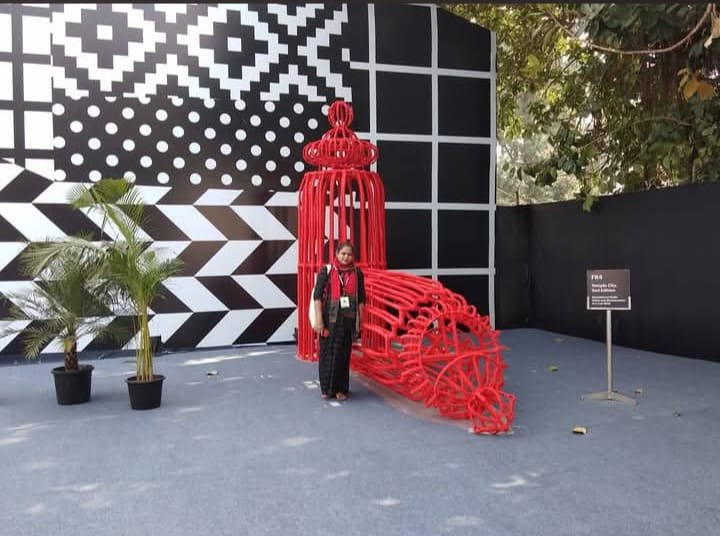
Although exhibitions remain an important part of her professional practice, she has also worked extensively through public art, community projects, workshops and educational initiatives. Her artistic activities have taken place in galleries, public spaces, schools and communities.
This approach challenges the idea that art must exist only as an object displayed inside a gallery. For Majhi, art can become part of everyday life.
A mural painted on a public wall, an artwork created with a community, a workshop conducted with children or an experiment using natural pigments can all become part of the artistic process.
A Foundation in Traditional Art
Majhi holds a Master of Fine Arts in Traditional Art, providing an important foundation for her understanding of India’s artistic traditions.
However, her subsequent career demonstrates that traditional art and contemporary practice do not necessarily exist as opposites.
Instead, Majhi has explored ways of carrying traditional references into contemporary contexts. Her work has incorporated cultural symbols, indigenous visual traditions, natural materials and regional experiences while also engaging with modern questions about urbanisation, identity, ecology and social change.
This combination of tradition and experimentation is particularly relevant to contemporary Indian art, where artists often negotiate between inherited cultural practices and rapidly changing social environments.
Odisha as an Artistic Landscape
Odisha has played a central role in Majhi’s artistic development.
Her base in Bhubaneswar has allowed her to observe the transformation of an evolving city, while her engagement with rural and indigenous communities has exposed her to very different cultural and environmental experiences.
These contrasting environments have contributed to the diversity of her practice.
Bhubaneswar represents urban development, modernization and changing neighbourhoods. The Niyamgiri region, meanwhile, provides a context in which landscape, indigenous culture, livelihood and ecological relationships become central.
By engaging with both environments, Majhi’s practice reflects the complexity of contemporary Odisha.
The Importance of Everyday Life
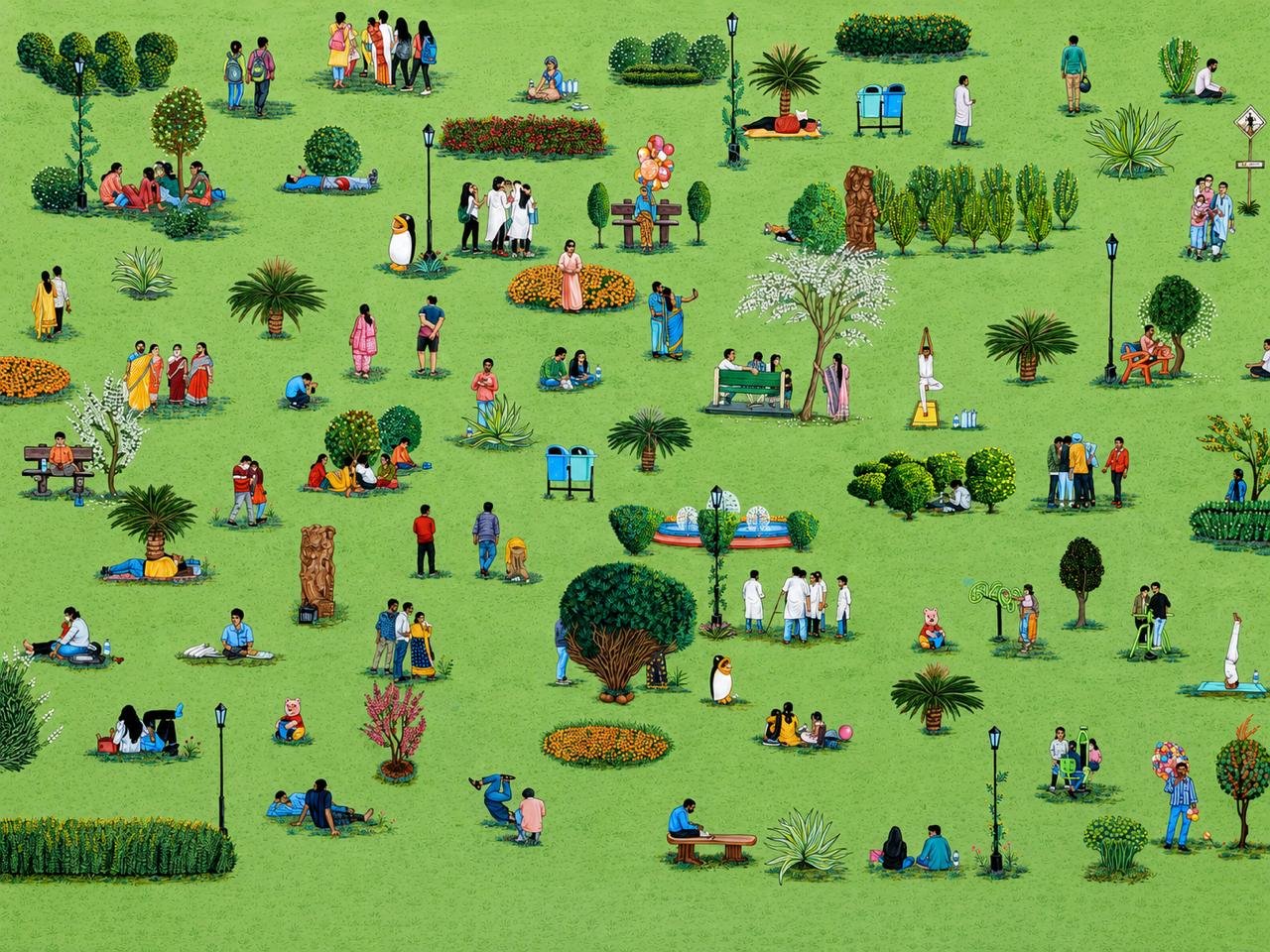
Majhi’s art frequently begins with observation.
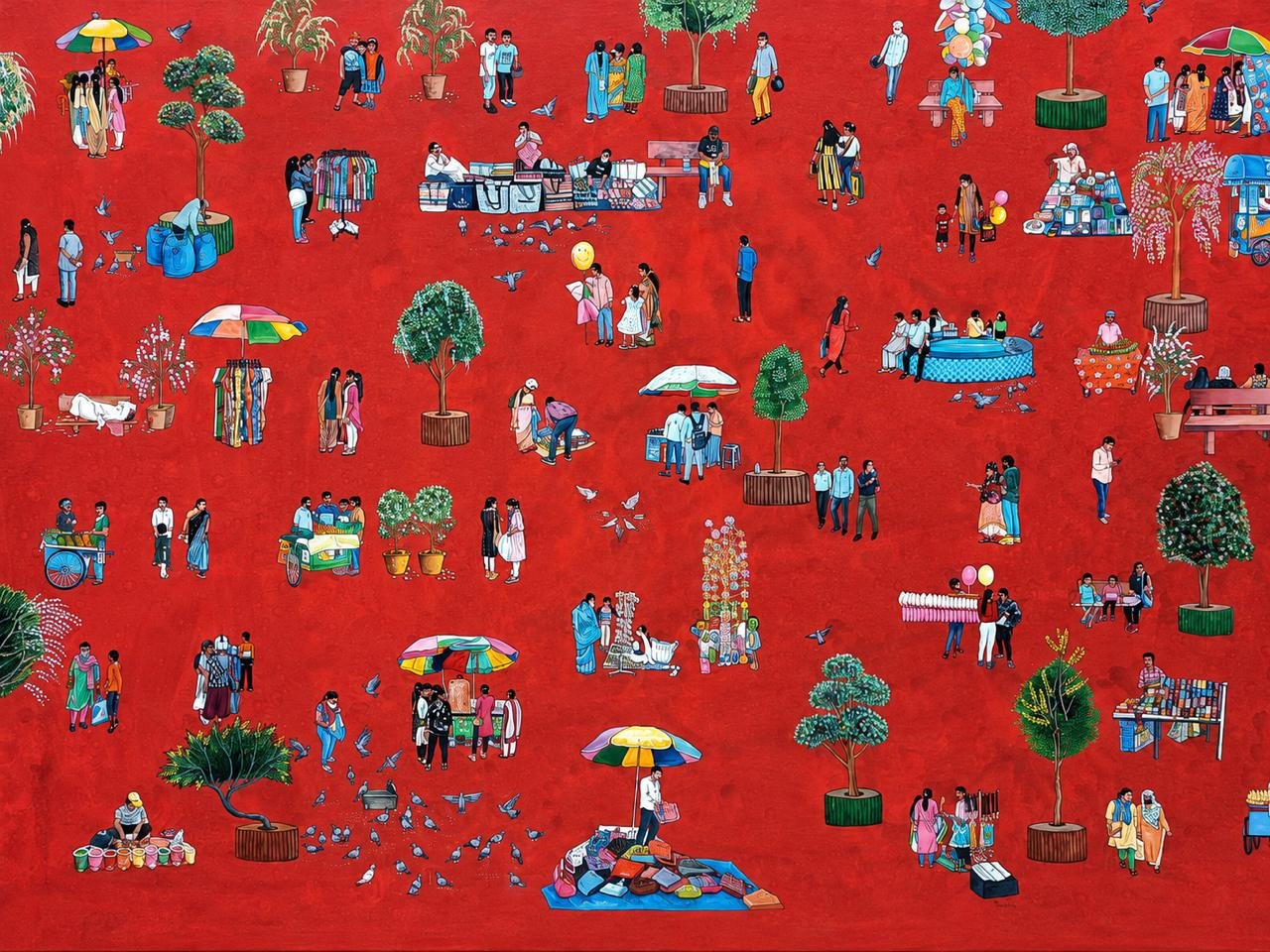
Her childhood experiences around her father’s shop in a local marketplace introduced her to the visual and social richness of everyday life. People, vendors, animals, celebrations and neighbourhood interactions became part of her early visual memory.
This interest in ordinary life has continued into her artistic practice.
Rather than concentrating exclusively on monumental historical events or famous personalities, her work often considers the experiences of ordinary people.
Groups of figures, animals, plants, architecture and everyday activities can coexist within her compositions, creating a sense of a living environment.
This emphasis on everyday experience is an important characteristic of contemporary art, where ordinary lives and local environments can become meaningful subjects of artistic investigation.
Urbanisation and Collective Memory
Modernization is another important concern in Majhi’s work.
Cities are constantly changing. Buildings disappear, roads expand, neighbourhoods are redeveloped and familiar environments are replaced by new structures.
For individuals and communities, however, these places often contain memories that cannot easily be replaced.
Majhi’s experience of Bhubaneswar has encouraged her to explore this relationship between urban development and memory.
Her work asks viewers to consider what happens to cultural identity when familiar environments change. It also highlights the importance of remembering the human stories attached to particular places.
Through this approach, the city becomes a subject of both visual and cultural enquiry.
Indigenous Culture and Contemporary Practice
Majhi’s sustained engagement with the Dongaria Kondh community represents another important aspect of her contemporary practice.
Her engagement with the community has extended for more than a decade and has involved observation and interaction concerning culture, livelihood, visual traditions and relationships with nature.
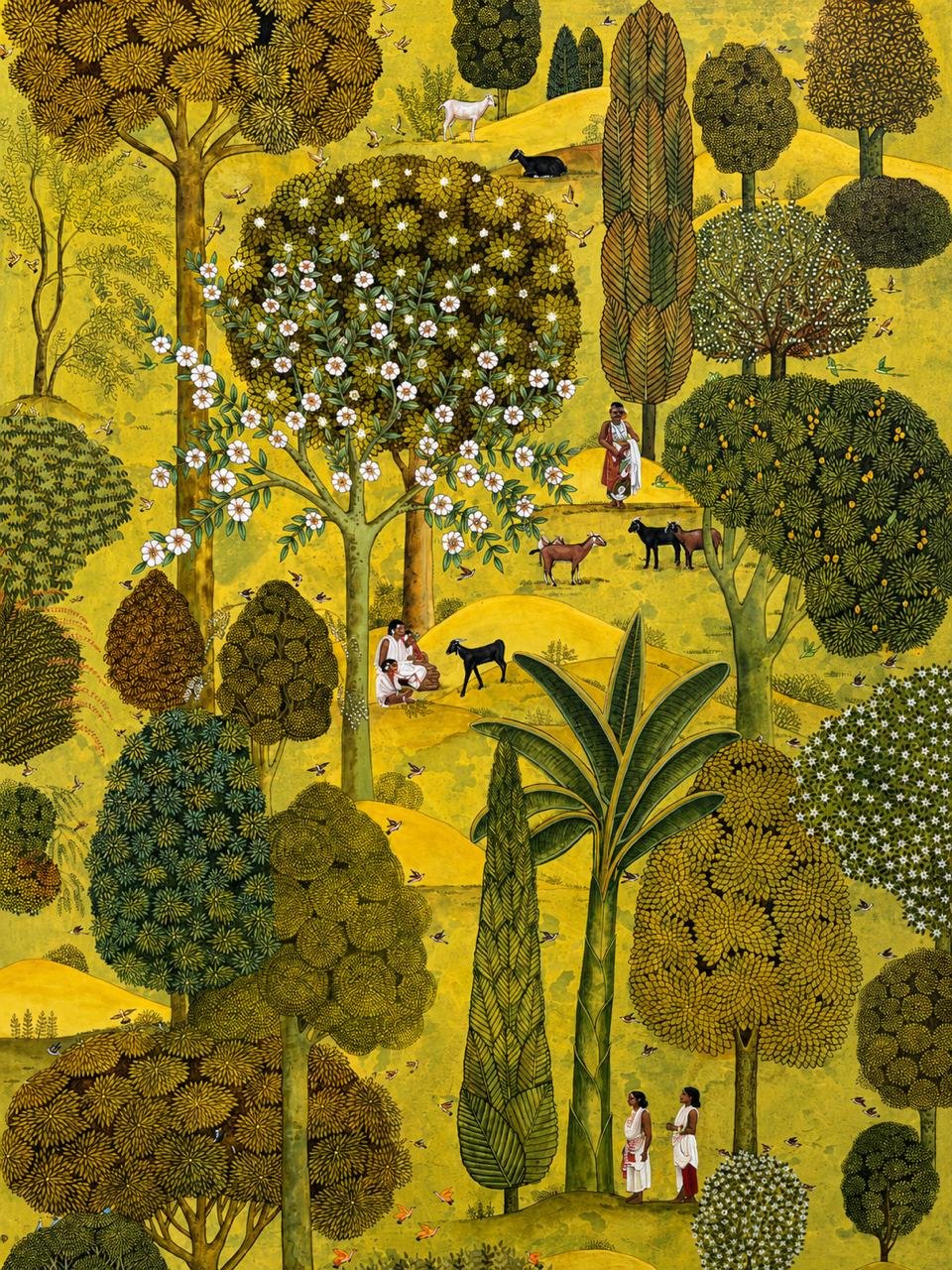
The Niyamgiri hills have become an important context for this exploration.
Her work examines relationships between landscape and identity, while also exploring cultural references associated with the community.
This kind of engagement reflects a broader movement in contemporary Indian art toward greater attention to indigenous knowledge and local cultural practices.
Rather than viewing indigenous traditions simply as historical subjects, contemporary artists can explore how these traditions continue to exist and evolve in the present.
Nature as Material and Meaning
Majhi’s engagement with Niyamgiri has also influenced her experiments with natural pigments.
Materials such as chalk stone, charcoal, turmeric, geru soil and brown stone have been explored as sources for colour.
This experimentation is significant because it connects the physical material of the artwork with the environment being explored.
Nature therefore operates at two levels: as a subject and as a material source.
The use of naturally derived materials also creates an artistic dialogue between contemporary practice and traditional methods of working with locally available resources.
Geometry and Cultural Symbolism
The use of geometric forms provides another connection between traditional references and contemporary visual language.
The triangle appears as an important motif in some of Majhi’s works influenced by Dongaria Kondh visual culture.
Within her artistic exploration, the triangular form can be associated with the shape of the Niyamgiri hills and ideas relating to landscape, stability, sacred geography and divinity.
A simple geometric form can therefore carry multiple meanings.
This demonstrates how contemporary artists can reinterpret cultural symbols rather than simply reproduce them.
Art as Participation
Perhaps one of the strongest characteristics of Majhi’s practice is participation.
Her public-art projects, community initiatives and educational programmes demonstrate an interest in involving people in the creative process.
This is particularly evident in her work with children.
For approximately 15 years, she has participated in art education and creative-learning activities involving schools and children. Her approach encourages children to use their own experiences and observations as sources of artistic expression.
Such work expands the role of the artist. The artist becomes not only a creator but also a facilitator, educator and participant in community life.
Public Art and a Wider Audience
Majhi has also contributed to public-art projects and murals in Odisha.
Her documented public-art activities include projects in Cuttack and Bhubaneswar, along with initiatives associated with major sporting and cultural events.
Projects connected with the Men’s FIH Hockey World Cup, Asian athletics events, Pago and Thought Loom demonstrate her engagement with public spaces.
Public art allows an artist to reach audiences who may never visit a gallery.
A person walking through a street can encounter a mural without intentionally seeking out an art exhibition. In this way, public art can make contemporary artistic expression part of everyday community experience.
A National Artistic Platform
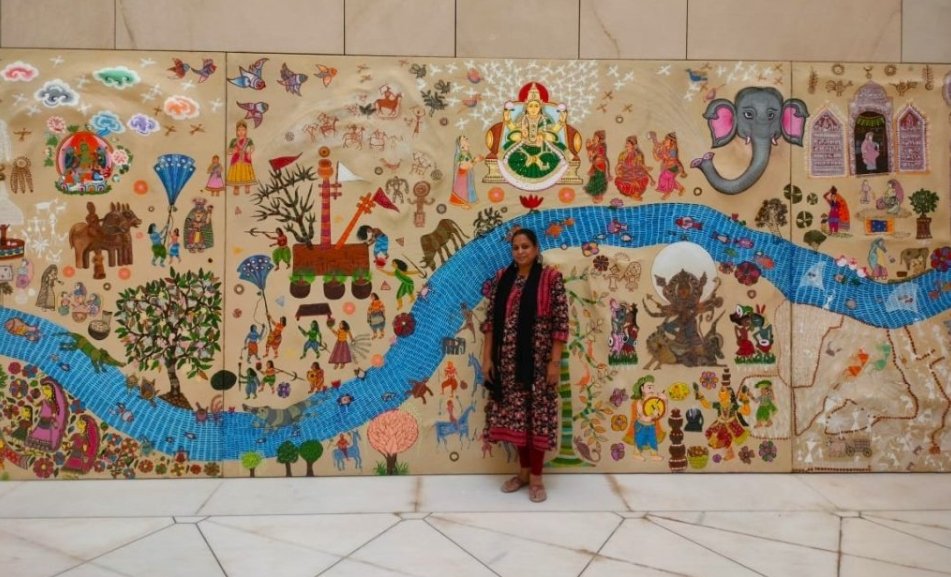
Majhi’s participation in People’s Wall – Jan, Janani and Janmabhumi in 2023 represents another significant aspect of her career.
She served as a Co-Sutradhar and creative contributor to the participatory project created for the New Parliament House in New Delhi through the Lalit Kala Akademi.
The project brought together women artists and artisans from different parts of India, incorporating regional artistic traditions and visual languages.
The project reflects an important direction in contemporary Indian art: collaboration between different artistic traditions and practitioners.
For Majhi, participation in such a national project connected her community-oriented practice with a major public cultural platform.
Recognition and Professional Development
Majhi’s career has received recognition from important art institutions.
She received the National Lalit Kala Akademi, New Delhi Scholarship for 2009–2010 and the Odisha Lalit Kala Akademi State Award in 2012.
Her professional engagements have also included platforms and initiatives such as Bharat Bhavan, Nature Morte, Lalit Kala Akademi, Odisha Lalit Kala Akademi, Bhubaneswar Art Trail, Gram Art Project and Vancouver Biennale-linked projects.
These experiences have contributed to the expansion of her artistic practice from regional contexts toward wider national and international artistic networks.
A Broader Definition of the Contemporary Artist
Satyabhama Majhi’s career illustrates how the definition of a contemporary artist is changing.
She is not limited to one medium or one type of audience. Her work moves between painting and public art, traditional references and contemporary experimentation, galleries and communities, urban environments and rural landscapes.
Her roles as artist, curator, educator, social activist and community practitioner overlap and inform one another.
As Secretary of the Sasatwa Foundation, she also participates in work that connects artistic activity with community and social engagement.
The Continuing Evolution of Her Practice
The significance of Majhi’s artistic practice lies in its ability to connect different worlds.
Her work brings together tradition and modernity, city and village, individual and community, culture and ecology, material and memory.
Rather than treating these subjects as separate, she explores the relationships between them.
Her artistic journey demonstrates that contemporary Indian art can remain deeply rooted in local experiences while participating in wider national conversations.
From the changing streets of Bhubaneswar to the landscapes of Niyamgiri, from natural pigments to public murals, from children’s workshops to national collaborative projects, Majhi’s career reflects a continuing exploration of what art can mean in contemporary society.
Her work ultimately suggests that contemporary art is not only about creating new images. It can also be about remembering places, engaging communities, understanding cultural traditions, observing environmental change and creating spaces for dialogue.
In this sense, Satyabhama Majhi’s practice represents an evolving chapter in contemporary Indian art—one in which artistic expression is closely connected with people, place, culture and the environment. (wikigenuine.org)